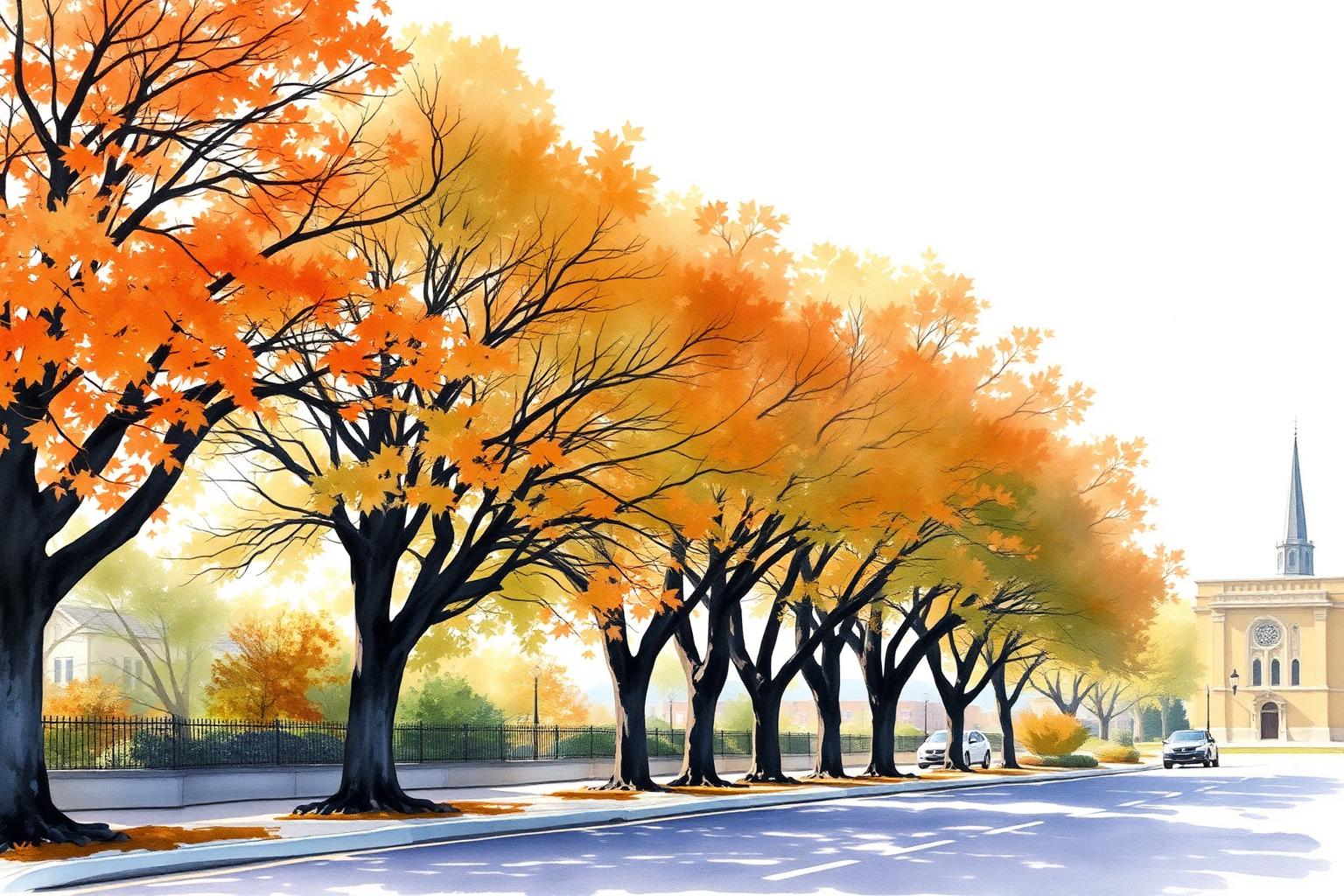
Trees are the longest sentence a place writes about itself. A two-hundred-year-old oak on a property line is older than most American towns, and it has been quietly recording rainfall, drought, soil chemistry, and human decisions for the entire span. The structure of a neighborhood's canopy — what species are present, in what proportion, at what age — is, in effect, a written record of the choices that came before us.
What canopy tells you that other signals miss.
- Heat. A street with 40% canopy cover can run 5–10°F cooler in summer than a bare one a block away. Canopy is the most legible climate adaptation a community has.
- Stormwater. A mature shade tree intercepts thousands of liters of rainfall per year before it ever reaches a storm drain. Loss of canopy upstream becomes flooding downstream.
- Equity. Canopy maps overlay almost perfectly onto historical redlining maps in most American cities. Where the trees are tells you who the city has invested in.
- Resilience. Diversity matters as much as cover. A street that is 80% one species — ash, elm, callery pear — is one pathogen away from disappearing. Diverse canopies survive things monocultures cannot.
"The vast possibilities of our great future will become realities only if we make ourselves responsible for that future."
The data already exists. You don't have to gather it.
Hundreds of cities now publish their public tree inventories openly. OpenTreeMap holds millions of trees mapped by community groups and arboriculture programs. The USFS publishes a national 30-meter canopy raster updated annually. The i-Tree suite of tools, also free, can convert any inventory into per-tree estimates of carbon, stormwater, energy savings, and air-quality benefits.
What this means for a stewardship organization is simple: in most parts of the country, you do not need to send a volunteer with a clipboard to start understanding your local urban forest. You need to read what arborists, municipalities, and the federal government have already published — and to read it through a stewardship lens, on a stewardship timescale.
How to read your local tree data, in three steps.
- Anchor a baseline. Pull the satellite canopy percentage for your preserve or neighborhood. Note it. That is the number you will compare every five years from now on.
- Read the species mix. From OpenTreeMap or your municipal inventory, pull the top ten species nearby. A healthy canopy carries no single species above ~10%. Anything above 25% is a vulnerability.
- Translate the benefits. Use i-Tree-style averages to express the canopy as cooling, stormwater interception, and carbon. The numbers are imprecise, but they are the language a city council understands.
"The earth is the Lord's, and the fullness thereof; the world, and they that dwell therein. The chief care of man is to maintain that fullness."
The stewardship use.
Trees, like birds, are most useful as an argument. They are how a land trust shows a town that the shaded creek bank is also flood control, that the old hedgerow is also carbon, that the oak woodlot is also a hundred-year insurance policy on the neighborhood's drinking water. Arborists already give us the inventory. Stewards' job is to give it meaning — and to make sure the next generation of trees gets planted while the old ones still stand.